Muziku V Formate Dsf Dsd Torrent
It seems like there’s always some hot-button issue for audiophiles to debate. For the last couple of years, it was the ability to play high-resolution (176.4 or 192kHz/24-bit) computer-audio music files. Now it’s almost impossible to find a DAC that won’t play files with at least 192/24 resolution, and many will play 384kHz/32-bit files, even though such files aren’t yet commercially available. This year, the hot-button issue is whether a digital audio system (server and DAC) will play Direct Stream Digital (DSD) files in their native format, without converting them to pulse-coded modulation (PCM) files first.
A consortium of industry gurus devised a way to do that, and both server and DAC manufacturers have labored long and hard to produce DSD-capable playback gear. What has been missing until recently is a significant number of commercially available DSD music files to play on the hardware. We thought it might be useful to survey the field to see which sites currently offer DSD and what’s coming. We’ll also review what equipment is available to play DSD recordings without first converting them to PCM.
May 23, 2018. Listen to it? We explain all about this niche audiophile digital music format. The DSD format seems to be back in fashion again. On a download site, you may occasionally come across the terms DSF and DFF. These are two. Active vs passive speakers: What's the difference?
But first, in case you haven’t been following this issue, let’s review a few basics. Direct Stream Digital, or DSD, is a recording system used to master Super Audio CDs (SACDs).
Although for a variety of reasons, the SACD wasn’t as successful as its developers would have liked, many recording engineers liked the sound produced by the DSD recording process. But until recently, playing back DSD files directly wasn’t easy unless you had professional equipment.
Sony offered playback of DSD files on two of its SACD players and on its VAIO computers. Daewoo dwf 5586dp instrukciya 1. SACDs are copy-protected, so (except for the aforementioned Sonys) they can’t be read by any other consumer equipment that can play pure DSD files. A PCM (Pulse Code Modulation) encoding system samples an analog waveform from, say, a microphone many times each second. Each sample is a “snapshot” of the analog waveform’s amplitude at the time the sample is taken. The frequency at which the waveform is sampled is called the sampling rate. The waveform’s amplitude is encoded as a binary number (“word”) which in the case of CD is 16 bits long.
Each 16-bit sample can encode one of 65,536 discrete amplitude levels. For high-resolution PCM files, the sampling rate may be as high as 352.8kHz, with a word length of 24 bits, or 16,777,216 discrete amplitude levels.
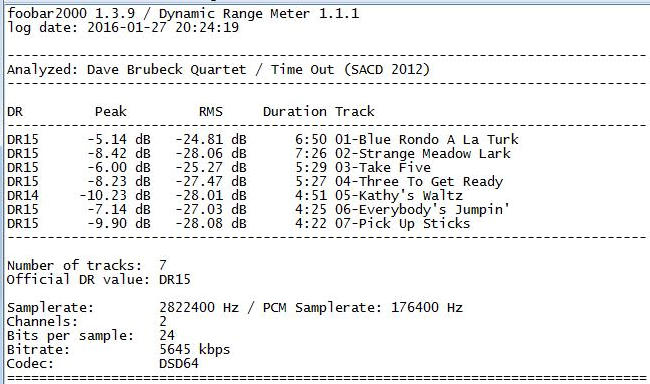
With today’s computing power, even higher sampling rates and longer word lengths are possible, but so far these higher rates and longer word lengths have not been used (the limitations are the analog-to-digital and digital-to-analog converters). The resultant bitstream can be stored as files on a computer in a variety of formats, including WAV, FLAC, AIF, or M4A files. There are several other uncompressed PCM file formats, but the first three formats (WAV, FLAC, and AIF) can be played by all of the high-end music players I’ve tried. DSD, on the other hand, uses a much higher sampling rate, 2.8224MHz, or 2,822,400 samples per second. That’s 64 times as fast as the sampling rate for CDs. But the word length is only one bit.
If that bit is a “1,” the amplitude of the signal is increasing; if it’s a “0,” the signal amplitude is decreasing. The actual waveform is encoded by the frequency or density of the “1s” and “0s.” An actual sample of a musical waveform takes the form of a series of pulses of varying density (those “1s” and “0s” clumped together) and actually looks a bit like an analog waveform. When stored on a computer, DSD files have the file extensions DFF or DSF. If you’d like to delve deeper into how digital audio works, I’d highly recommend Robert Harley’s indispensable book The Complete Guide to High-End Audio.